Short treatment windows
Choose a workflow that fits buildup, pollination, post-harvest work, and the realities of remote yards.
ApiVera was designed to help beekeepers thrive by supporting healthier colonies and making treatment workflows easier to carry out at commercial scale.
Per hive with the Backpack Mister for Hive Health in single-deep workflows.
Choose a workflow your team can learn quickly and repeat across remote yards.
Size your Hive Health needs first, then request pricing based on volume and shipping.
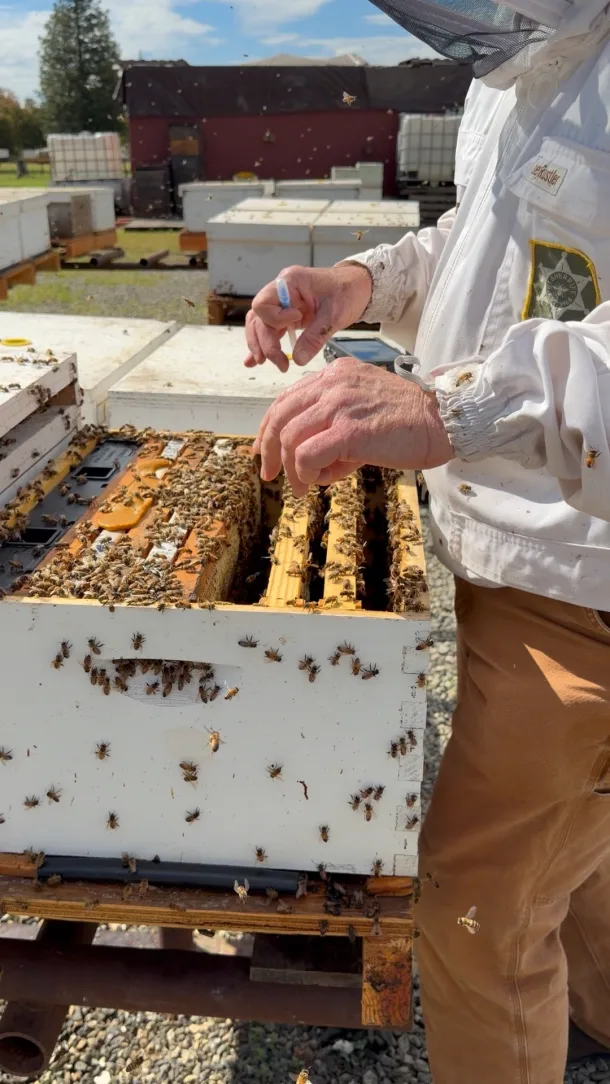
Choose the method that fits the yard. Plan the timing. Give crews a repeatable process. Measure the outcomes that matter.
When losses climb, the impact shows up everywhere: more replacement cost, more labor, weaker production, and more pressure on the business. ApiVera is designed to help operators run a treatment workflow that is practical, trainable, and easier to scale.
Choose a workflow that fits buildup, pollination, post-harvest work, and the realities of remote yards.
Give seasonal crews a process they can learn quickly and repeat with more consistency.
Commercial operators care about bee safety, queen safety, crew safety, and field practicality.
Keep the conversation focused on mite pressure, queen health, pathogens, nutrition, brood pattern, and survivability.
ApiVera adapts to the way you work. Start with the treatment window, choose the application method that fits the yard, and give crews a repeatable process they can follow with confidence.
Map treatment timing around buildup, transport, honey flow, post-harvest work, and overwintering preparation.
Select the right application workflow by throughput, mobility, power access, and yard setup.
Roll out a simpler field process with clearer equipment choice, application guidance, and team support.
Use Hive Health with live colonies throughout the season. Use Hive Wash on deadouts, empty boxes, tools, and equipment when no live bees are present.
The honey flow program for commercial operators treating live colonies.
Do not apply Hive Health at the same time as an essential oil–based hive product. If one was used previously, test a limited number of representative hives and observe them for 24 hours before broader application.
The cleaning workflow for empty equipment when no live bees are present.
Compare cost, crew involvement, power, and the main advantage of each method.
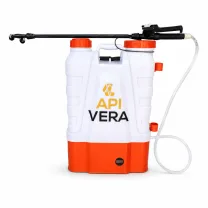
Mobile, fast, and well-suited to crews moving through remote or irregular yards.
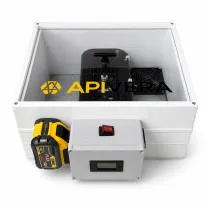
Automated, repeatable on-hive application.
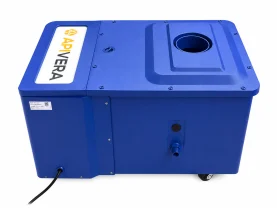
The automated option for palletized, high-volume commercial workflows.
We have worked alongside researchers and commercial beekeepers in the field to ensure ApiVera addresses the challenges operators face—from queen performance and mite pressure to pathogens, nutrition, and survivability.
Queen quality supports brood continuity and long-term colony performance.
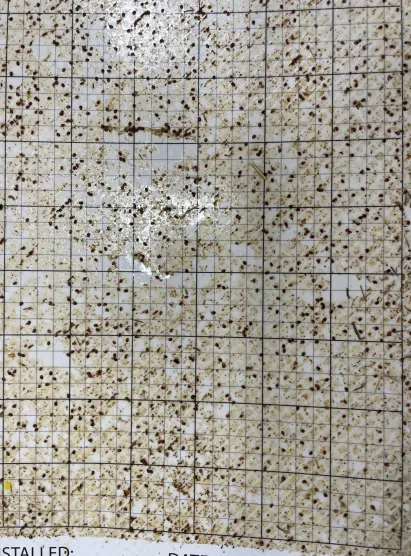
Operators want to know whether a treatment is making a visible difference in pressure.
Pathogen pressure can influence survivability and the economics of rebuilding.
Resilient colonies need support, not just pressure knockdown.
Visit the main ApiVera resources section for the broader library of research briefs, case studies, field observations, and beekeeper education materials.
Go to ApiVera resourcesApiVera can be incorporated into spring, honey flow, and fall workflows. Choose the application method that fits the yard, then plan around workable weather and good hive coverage.
Plan treatments around spring buildup, honey flow needs, or fall preparation.
Avoid very cold conditions and choose a workable window for the crew and colonies.
Match the equipment to yard access, crew size, power availability, and throughput goals.
Follow the application guide and use the same process across crews and yards.
Plan treatments for workable weather, then use a consistent crew process to achieve thorough hive coverage across the yard.
The right commercial plan depends on hive count, application frequency, workflow choice, and how product needs to ship. Size the Hive Health program first, then price it around your real operating needs.
Estimate treatment equivalents and kit needs, then use those numbers to request a tailored commercial quote.
Commercial pricing is customized around your hive count, treatment frequency, and expected seasonal volume.
Choose from application methods designed to fit different operation sizes, yard layouts, labor models, and treatment workflows.
We customize each program around how you keep and move your bees, including operations that transport colonies across the country and work within tight treatment windows.
Our team supports you through setup, in-season execution, and preparation for the next cycle—from equipment and crew training to treatment planning and follow-through.
This estimator is specifically for ApiVera Hive Health. Enter your hive count, box configuration, and planned applications, and we’ll translate that into Hive Health treatment equivalents and an approximate kit requirement.
Use the number of colonies you expect to treat in a typical application round.
A double-deep colony uses twice the Hive Health volume of a single deep: 600 mL instead of 300 mL.
One kit provides approximately 35 single-deep treatment equivalents.
Hive Health estimate: hives × seasonal applications × box multiplier ÷ 35 single-deep treatments per kit.
10,000 double-deep hives treated twice equal 40,000 single-deep treatment equivalents, or approximately 1,143 kits.
Hive Health planning estimate only. One Hive Health kit is assumed to provide approximately 35 single-deep treatments at 300 mL each. Final needs may vary by field use, equipment, product handling, and operational conditions.
Answers to common questions about products, application methods, seasonal use, pricing, and implementation.
Use Hive Health with live colonies during spring buildup, honey flow, and fall preparation. Use Hive Wash on deadouts, empty boxes, tools, and equipment when no live bees are present.
Compatibility depends on the ApiVera product and the treatments currently or previously used in the hive. Hive Health should not be used concurrently with essential oil–based hive products. When one has been used previously, complete a small-scale compatibility test before broader application.
The Backpack Mister is the most mobile and operator-driven option. The On-Hive Fogger provides an automated, repeatable workflow for single- and double-deep hives. The High Efficiency Fogger is designed for higher-throughput, palletized commercial workflows.
Treatment time depends on the application method, hive configuration, yard layout, and crew process. A Backpack Mister treatment for Hive Health can take approximately 10–20 seconds per single-deep hive, while automated systems prioritize repeatability and throughput.
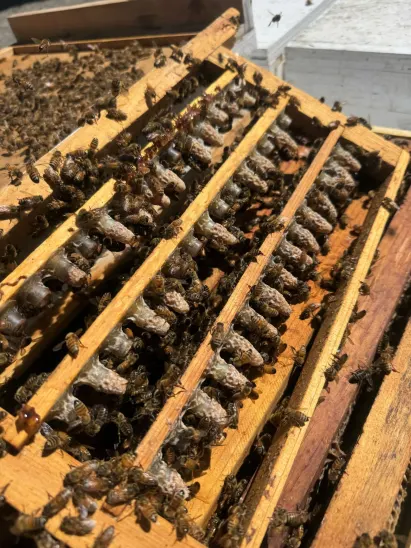
Hive Health is intended for use with live colonies. In the queen-rearing field study, no immature queen mortality was observed in the treated groups. Stronger brood patterns have also been observed in the field compared with colonies managed using other treatment methods; see the brood pattern field observations. Follow the product and application guidance for your selected workflow.
Start with your hive count, hive configuration, planned number of applications, and application method. Use the Hive Health estimator on this page to convert those inputs into treatment equivalents and an approximate number of kits.
Hive Health planning estimates use an average of 250 mL per single-deep treatment, or about 42 treatments per kit. For double-deep colonies, plan for approximately 500 mL per treatment, or about 21 treatments per kit. Hive Wash planning estimates use an average of 280 mL per hive box, within the average 280 mL dose, or about 25 treatments per kit. Actual usage may vary by application method, equipment configuration, hive setup, and crew technique.
Commercial pricing is customized around hive count, treatment frequency, expected seasonal volume, equipment needs, and shipping requirements. Request a commercial quote to build a plan around your operation.
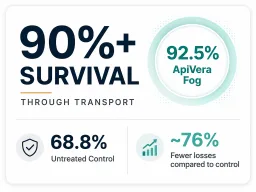
Yes. Program timing, equipment, product volume, and shipping can be planned around how and when your colonies move, including tight windows before or after transport. See the commercial transport case study.
The team can help with equipment selection, treatment planning, usage estimates, crew rollout, in-season questions, and preparation for the next treatment cycle. Discuss your operation with the team.
We’ll help you turn that into a commercial ApiVera plan—whether you are sizing Hive Health for live colonies or Hive Wash for deadouts and equipment prep.
Discuss volume, shipping, and the structure of the order.
Match Backpack, On-Hive, or High Efficiency workflow to the operation.
Talk through seasonal timing, application cadence, and field guardrails.
Make the program easier to implement once the product reaches the yard.
Share a few details about your operation and what you need. We’ll use them to recommend the right product volume, equipment, timing, and shipping approach.
Thanks — your request has been submitted. Terra Vera will send a quote via email.
Hive Health guidance
Complete this check before broader use if an essential oil–based hive product was used previously or if you are unsure of the hive’s treatment history.
Important compatibility information
Hive Health is an oxidative chemistry that may react with essential oil–based products. Do not use Hive Health in conjunction with these products. If an essential oil–based product has been used previously, complete a small-scale compatibility test before treating the full hive or apiary. Read and follow all instructions carefully.
If you are unsure whether the hive is ready for Hive Health, contact Terra Vera before proceeding with full application.
If no unusual response is observed: you may proceed with broader treatment.
If you observe an adverse reaction, bees avoiding the area, or a strong odor: do not continue. Contact Terra Vera before proceeding.